Mochi Donut vs Regular Donut: What's the Difference?
Rice flour vs wheat, chewy vs fluffy, 8-ball ring vs classic O — the six real differences, plus how a mochi donut stacks up against a malasada and where to try both in Waikīkī.
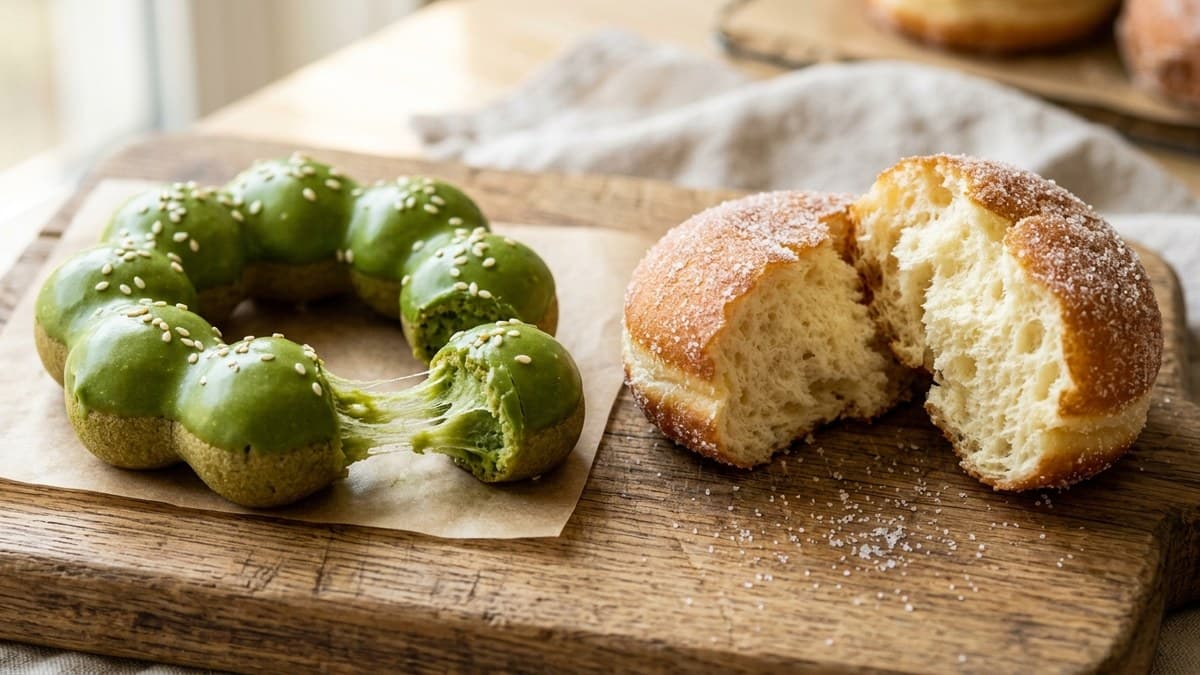
A mochi donut is a ring of eight small dough balls joined into a circle, made with glutinous rice flour or tapioca starch instead of wheat flour. That swap gives it a chewy, bouncy, slightly springy bite — the texture Japanese speakers call "mochi-mochi" — rather than the fluffy crumb of a yeast donut or the tender, crumbly crumb of a cake donut. It is glazed rather than heavily sweetened inside, pulls apart one ball at a time, and is at its best within hours of frying. At Kona Coffee Donut on Kalākaua Avenue we fry ours in-house every morning and never freeze them, so this guide is written from the fryer forward: what a mochi donut actually is, the six ways it differs from a regular donut, how it compares to a Hawaiian malasada, and which flavor to order first.
Try Both Side by Side in Waikīkī
Twenty-four mochi donut flavors ($3.95 each, 3 for $11.25) and classic Portuguese malasadas ($3.95) fried fresh every morning at 2142 Kalākaua Ave — about five minutes from Waikiki Beach, open 7 AM to 9 PM daily, walk-in only.
What Is a Mochi Donut? (Short Answer)
A mochi donut is a chewy donut made from glutinous rice flour or tapioca starch rather than wheat flour, shaped as a ring of eight connected balls and finished with a thin glaze. The rice-flour dough fries into a light, bouncy, "mochi-mochi" texture that is denser than a yeast donut but far less cakey than a cake donut. The style is often traced to Japan's "pon de ring" and to Hawaii's long love of mochi, and it took off across the United States in the late 2010s. In prose you will also see it called a mochinut, a pon de ring donut, or a Hawaiian mochi donut — they all describe the same 8-ball chewy ring.
Mochi Donut vs Regular Donut: 6 Differences
The short version: a mochi donut is chewy, glaze-led and eaten one ball at a time; a regular donut is fluffy or crumbly, sweeter through the dough, and eaten in bites. Here is the full comparison:
- •Dough — Mochi donut: glutinous rice flour and/or tapioca starch, a soft batter that is piped rather than rolled. Regular donut: wheat flour, either a yeast-risen dough (raised donuts) or a chemically leavened batter (cake donuts).
- •Texture — Mochi donut: chewy, bouncy, springs back when you press it, light in the mouth. Yeast donut: airy and pillowy. Cake donut: dense, tender, crumbly.
- •Shape — Mochi donut: an 8-ball "pon de ring" that pulls apart. Regular donut: a solid O-ring, or a filled round with no hole.
- •Sweetness — Mochi donut: the dough itself is only mildly sweet; nearly all the flavor comes from the glaze or topping, so the overall bite is lighter. Regular donut: the dough carries more sugar and fat, and the glaze is added on top of that.
- •Freshness window — Mochi donut: best within a few hours of frying, because rice starch firms up faster than wheat crumb as it cools. Regular donut: still decent the next morning, especially cake donuts.
- •How you eat it — Mochi donut: twist off one ball at a time, no knife, no crumbs. Regular donut: bite straight in.
Mochi Donut vs Malasada
In Hawaii the "regular donut" you are most likely to meet is the malasada — a Portuguese yeast donut brought by Azorean plantation workers in the 1800s and now a state classic. A malasada is a hole-less ball of eggy wheat dough, fried and rolled in sugar, with a crisp shell and a soft, fluffy, faintly bready interior. A mochi donut is the opposite experience: chewy instead of fluffy, glazed instead of sugared, pull-apart instead of one big bite. Neither is "better" — they answer different cravings. We make both. Our malasadas come Original, Cinnamon or Ube at $3.95, and filled with Custard, Ube Cream, Nutella, Macadamia, Coconut or Red Bean at $4.95, so you can taste the fluffy-vs-chewy contrast in a single visit.
Why Fresh Matters More for Mochi Donuts
Gelatinized rice starch is what makes a mochi donut chewy, and it is also why the clock runs faster on it. As the donut cools past a few hours the starch retrogrades — the same thing that turns day-old mochi hard — and the bounce slowly turns to firmness. Wheat donuts stale too, but their crumb hides it better. Freezing and thawing is harder still on rice-flour dough, which is why we do not do it: every mochi donut at Kona Coffee Donut is mixed, deposited and fried in our own kitchen each morning, then glazed and racked the same day. If you want the textbook "mochi-mochi" bite, buy in the morning or early afternoon and eat within a few hours. If you are carrying them back to the hotel, keep the box out of the sun and do not refrigerate — the cold speeds up firming.
Which Flavors to Try First in Waikīkī
We run 24 mochi donut flavors, all $3.95 each, 3 for $11.25, 6 for $22.50 or a dozen for $45. If you are new to mochi donuts, order a trio that shows off the range:
- •Ube — the purple Hawaii-Filipino classic, sweet and vanilla-like; the flavor most visitors photograph first
- •Matcha — earthy green tea glaze that plays against the mild dough
- •Black Sesame or Injeolmi — nutty, roasted, the most "Asian bakery" of the lineup
- •Cinnamon Sugar or Churro — the closest bridge from a regular donut, if you want the chew without a new flavor
- •Kona Coffee — our house glaze, made to pair with the coffee in your other hand
- •Also in the case: Nutella, Cookies & Creme, Yuzu, Taro, Milk Tea, Pistachio, Strawberry, Mango and more
Pairing With Kona Coffee
Because mochi donuts are lightly sweet, they do not need a sugary drink beside them; a clean, medium-bodied cup lets the glaze do the talking. Our 100% Kona coffee ($7) is the classic match — low acidity, nutty and smooth against a Black Sesame or Kona Coffee donut. On a hot Waikīkī afternoon the Kona cold brew ($6.95) works with the fruit glazes like Mango, Strawberry or Yuzu. And if you want the full dessert, the Kona affogato ($8.50) — espresso over ice cream — next to a pulled-apart Ube donut is the order regulars come back for.
Keep Reading
Frequently Asked Questions
Taste the Difference on Kalākaua
24 mochi donut flavors and classic malasadas, fried fresh every morning and never frozen. Open 7 AM – 9 PM daily, five minutes from Waikiki Beach, walk-in only.