Kona Coffee vs Regular Coffee: What Makes Hawaii's Famous Coffee Worth It
A complete guide to understanding why Kona coffee stands apart from every other coffee in the world
Quick Answer
Kona coffee is grown exclusively on the volcanic slopes of Mauna Loa and Hualalai in Hawaii's Kona District, representing less than 1% of the world's coffee production. Hand-picked and sun-dried, it delivers a uniquely smooth, low-acid flavor with chocolate and nutty notes that regular mass-produced coffee cannot replicate. Expect to pay premium pricing for 100% Kona coffee.
What Is Kona Coffee?
Kona coffee is a premium single-origin coffee grown exclusively in the North and South Kona Districts on the Big Island of Hawaii. The coffee belt stretches along the western slopes of two volcanic mountains — Mauna Loa and Hualalai — at elevations between 500 and 900 meters above sea level.
What makes this region so special is a rare combination of natural conditions: rich volcanic soil packed with minerals, consistent cloud cover that rolls in each afternoon providing natural shade, gentle tropical rainfall, and mild temperatures that never freeze. This microclimate exists nowhere else on Earth and creates ideal growing conditions for Coffea arabica.
Kona coffee has been cultivated since the 1820s, making it one of the oldest commercial coffee-growing regions in the United States. Today, approximately 800 small farms — most under 5 acres — produce the entire world's supply of Kona-grown coffee. Every cherry is hand-picked at peak ripeness, a labor-intensive process that ensures only the best beans make it to your cup.
The Kona Coffee Council and the Hawaii Department of Agriculture enforce strict grading standards. To be labeled "Honolulu Coffee," every bean must be grown, harvested, and processed within the Kona District. This level of traceability and quality control is virtually unmatched in the coffee world.
Kona Coffee vs Regular Coffee: Side-by-Side Comparison
| Factor | Kona Coffee | Regular Coffee |
|---|---|---|
| Growing Region | Kona District, Big Island, Hawaii only | Worldwide (Brazil, Colombia, Vietnam, etc.) |
| Altitude | 500-900 meters (volcanic slopes) | Varies widely (sea level to 2,000m+) |
| Harvesting | Hand-picked at peak ripeness | Mostly machine-harvested |
| Production Volume | Less than 1% of global supply | 98%+ of global supply |
| Flavor Profile | Smooth, chocolate, nutty, low acidity | Varies widely by origin and processing |
| Price per Pound | $30-50 (Honolulu Coffee) | $8-15 (commercial grade) |
| Certification | Kona Coffee Council, Hawaii DOA grading | Varies (Fair Trade, Rainforest Alliance, etc.) |
| Best For | Black coffee lovers, gifts, special occasions | Daily brewing, espresso blends |
Why Kona Coffee Costs More
At $30 to $50 per pound, Honolulu Coffee costs significantly more than standard supermarket coffee. Here's why the premium price is justified:
Labor-Intensive Hand Harvesting
Every Kona coffee cherry is picked by hand, one at a time. Skilled pickers select only ripe cherries during multiple passes through each farm over the harvest season (August through January). Machine harvesting — used for most commercial coffee — strips all cherries at once regardless of ripeness, producing an inconsistent product.
Extremely Limited Growing Area
The entire Kona coffee-growing region spans roughly 30 miles long and just 2 miles wide. You cannot expand this — the volcanic soil, elevation, and microclimate conditions are fixed by geography. This natural scarcity caps supply while global demand continues to grow.
Hawaii's Cost of Living
Farm workers earn Hawaii wages, which are significantly higher than those in Central America, Africa, or Southeast Asia where most commercial coffee is grown. Land costs, equipment, and utilities in Hawaii are among the highest in the United States.
Rigorous Quality Control
Hawaii state law requires Kona coffee to meet strict grading standards. Beans are sorted by size, moisture content, and defect count. Only beans meeting Extra Fancy, Fancy, No. 1, Select, or Prime grades can be sold as Kona coffee. Substandard beans are rejected entirely.
How to Spot Fake Kona Coffee
The biggest trap for consumers is the "Kona Blend" label. Here's what you need to know:
"Kona Blend" Warning
Hawaii law allows coffee containing as little as 10% Kona beans to be marketed as a "Kona Blend." The remaining 90% is typically cheap imported coffee from Central or South America. Many tourists unknowingly buy these blends thinking they're getting Kona-grown coffee. Major grocery store brands frequently sell Kona blends at premium prices.
- Always look for "Honolulu Coffee" on the label — not just "Kona" or "Kona Blend"
- Check for a specific farm name or the Kona Coffee Council certification
- Verify the roast date — fresh Kona coffee should be roasted within the past 2-4 weeks
- Be suspicious of prices under $20 per pound — genuine Honolulu Coffee cannot be produced that cheaply
- Buy directly from Kona farms or reputable specialty retailers
How to Brew Kona Coffee at Home
To get the most out of your Kona coffee, follow these expert brewing recommendations:
Recommended: Pour-Over Method
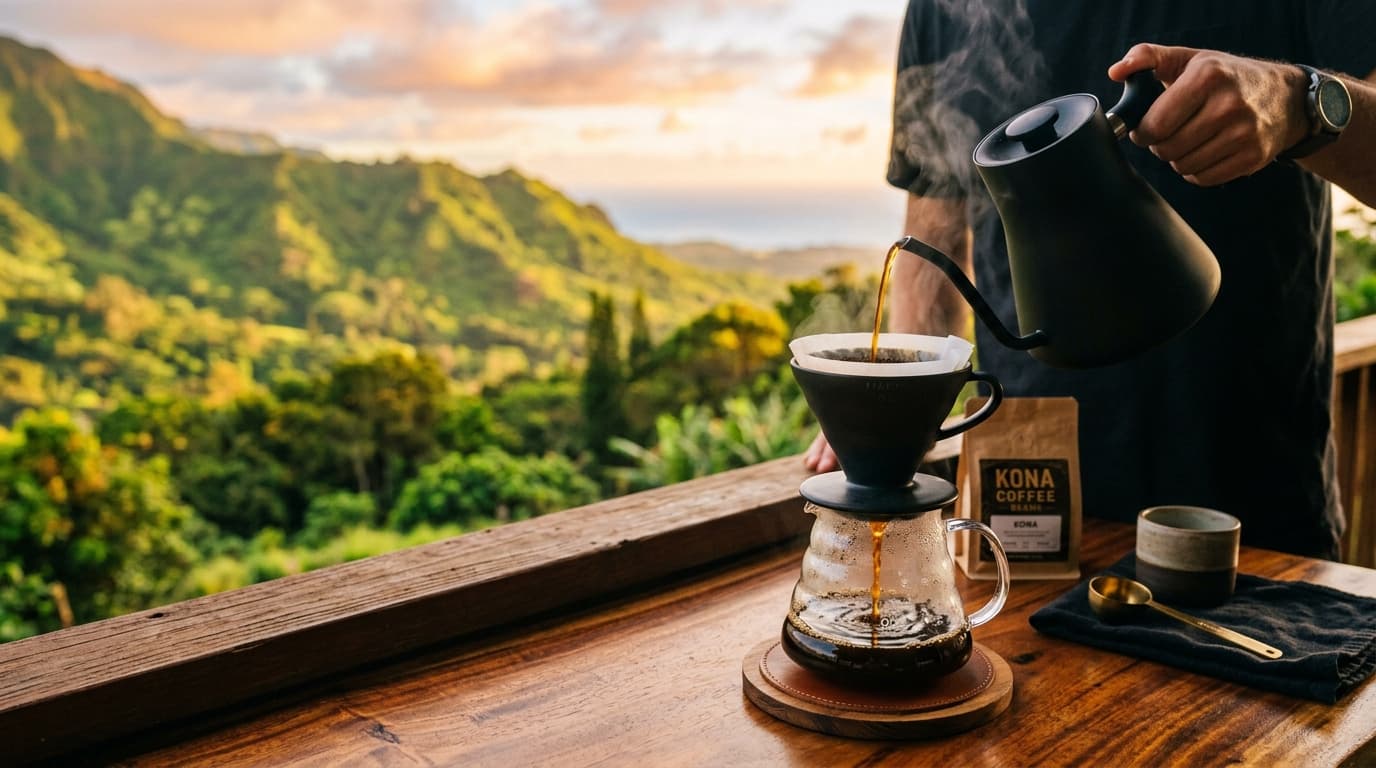
Pour-over brewing is the ideal method for Kona coffee because it highlights the bean's natural sweetness, smooth body, and delicate flavor notes without the bitterness that over-extraction can cause.
Pro tip: Drink Kona coffee black, at least for your first cup. Adding milk or sugar masks the subtle chocolate and nutty notes that make Kona special. If you typically need cream in your coffee, you may be surprised at how smooth Kona is on its own.
Where to Try Real Kona Coffee in Waikiki
Finding Kona coffee in Waikiki can be surprisingly difficult. Many cafes and hotel restaurants serve Kona blends (remember, only 10% real Kona) or skip Kona entirely due to cost.
At Kona Coffee Donut, we serve genuine Honolulu Coffee sourced through our partnership with Honolulu Coffee, established in 1992 and one of Hawaii's most respected coffee companies. Every cup we pour is made from beans grown on the volcanic slopes of the Kona District — no blends, no shortcuts.
We pair our Kona coffee with freshly made mochi donuts, malasadas, and other Hawaiian-inspired pastries at our location on Kalakaua Avenue, steps from Waikiki Beach. Whether you're a first-time visitor or a returning coffee enthusiast, tasting real Kona coffee the way it was meant to be enjoyed — freshly brewed, pure, and served with aloha — is an experience you won't forget.
Frequently Asked Questions
Is Kona coffee really better than regular coffee?
Yes, for most coffee drinkers. Kona coffee's unique growing conditions — volcanic soil, ideal altitude, and Hawaii's microclimate — produce beans with a distinctly smooth, low-acid flavor profile with chocolate and nutty notes. In blind taste tests, Kona consistently ranks among the world's top single-origin coffees. However, "better" is subjective; if you prefer bold, high-acid African coffees, Kona's mellow profile may not be your preference.
Why is Kona coffee so expensive?
Kona coffee costs $30-50 per pound due to hand harvesting (every cherry picked individually), extremely limited growing area (a 30-by-2-mile strip in Hawaii), high Hawaiian labor costs, and strict quality grading. Production accounts for less than 1% of global coffee supply, creating natural scarcity against growing worldwide demand.
What does Kona coffee taste like?
Kona coffee is known for its smooth, clean body with low acidity. Common tasting notes include milk chocolate, brown sugar, macadamia nut, and a subtle caramel sweetness. The finish is clean without bitterness. It is one of the most approachable and easy-to-drink black coffees in the world.
Is "Kona Blend" the same as Kona coffee?
No. "Kona Blend" legally only needs to contain 10% Kona beans — the other 90% is typically cheap imported coffee. Always look for "Honolulu Coffee" on the label to ensure you are getting the genuine product. The taste difference between a 10% blend and carefully sourced Hawaiian coffee is dramatic.
Where can I buy real Honolulu Coffee in Waikiki?
Kona Coffee Donut? on Kalākaua Avenue in Waikiki serves Honolulu Coffee and has 100% Kona coffee available. You can also find Kona-grown coffee at specialty retailers, but always verify the label percentage and specific farm origin.
Taste the Difference at Kona Coffee Donut
Experience Kona coffee at 2142 Kalākaua Ave, Waikiki. 100% Kona coffee available with fresh donuts and desserts.